
DeepSeek’s V4 drop repriced the US GPU market overnight. At Squaretower, we caught it early. Powerful new open model releases pose an unexplored risk in fragmented, low-supply segments of the compute market. The market is not ready.
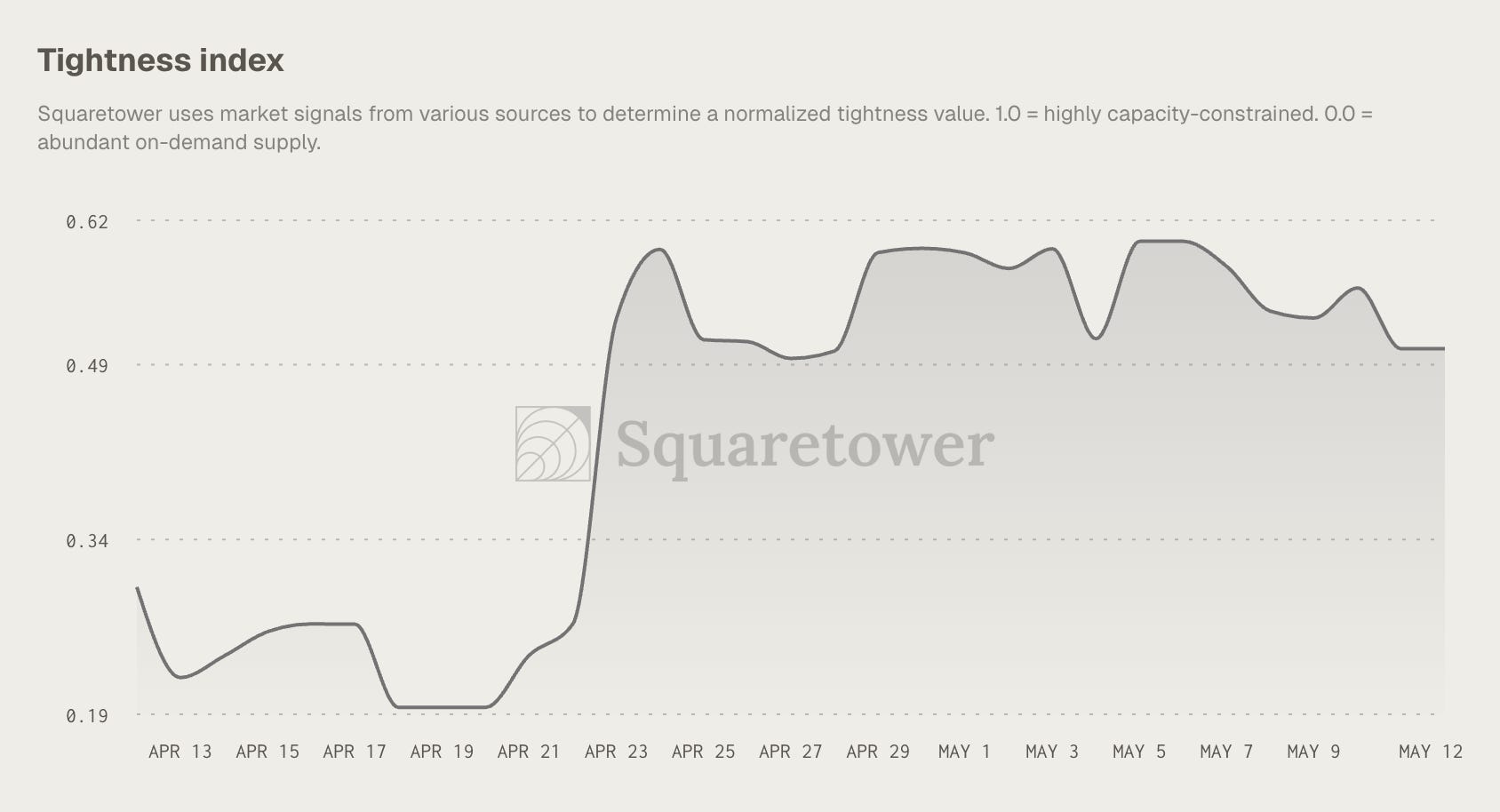
On April 22nd, rumors swirling around DeepSeek’s long-awaited V4 models came to a head. Confirmation that the model’s actual immediate release went wide. The market electrified and has since not returned to pre-release levels both in terms of pricing and market tightness. According to Squaretower’s H100 index, on-demand H100 instance prices rose 7.5% in the two weeks that followed. B200s saw an increase of 8.3% in a matter of days. Additionally, our H100 Market Tightness Index more than doubled overnight and sustained, with minor fluctuations, up until the time of this writing.
This is the clearest compute market event in recent memory where we watched compute reprice in real time, and the evidence is still coming in. This matters far beyond DeepSeek.
A market in name only
Until recently, the term “compute market” served more as a metaphorical gesture than a concrete, tangible market. Price discovery occurred, but wasn’t observable. This was and still is a real risk sitting on real balance sheets, and these risks are fundamentally misunderstood by the market at large. Labs vying for capacity, clouds writing forwards, enterprises inking multi-year contracts - all without any effective tool for hedging risk. This is a risk position that only stands to deepen as the market begins to reprice in realtime to uncertainty and events. DeepSeek V4’s price movements should be an alarm bell for anyone whose business has exposure to compute: from energy to data centers to models to tokens.
What happened with V4?
DeepSeek shipped V4-Pro and V4-Flash. Pro is a 1.6 trillion-parameter Mixture-of-Experts while Flash is its smaller/faster sibling; both have a one million-token context window. V4-Pro alone is too large to serve from a single 8 x H100 node and requires multi-node H100 or H200-class hardware to run at production latency. To date, V4-Pro has been downloaded over 2 million times. Those downloads had to go somewhere.
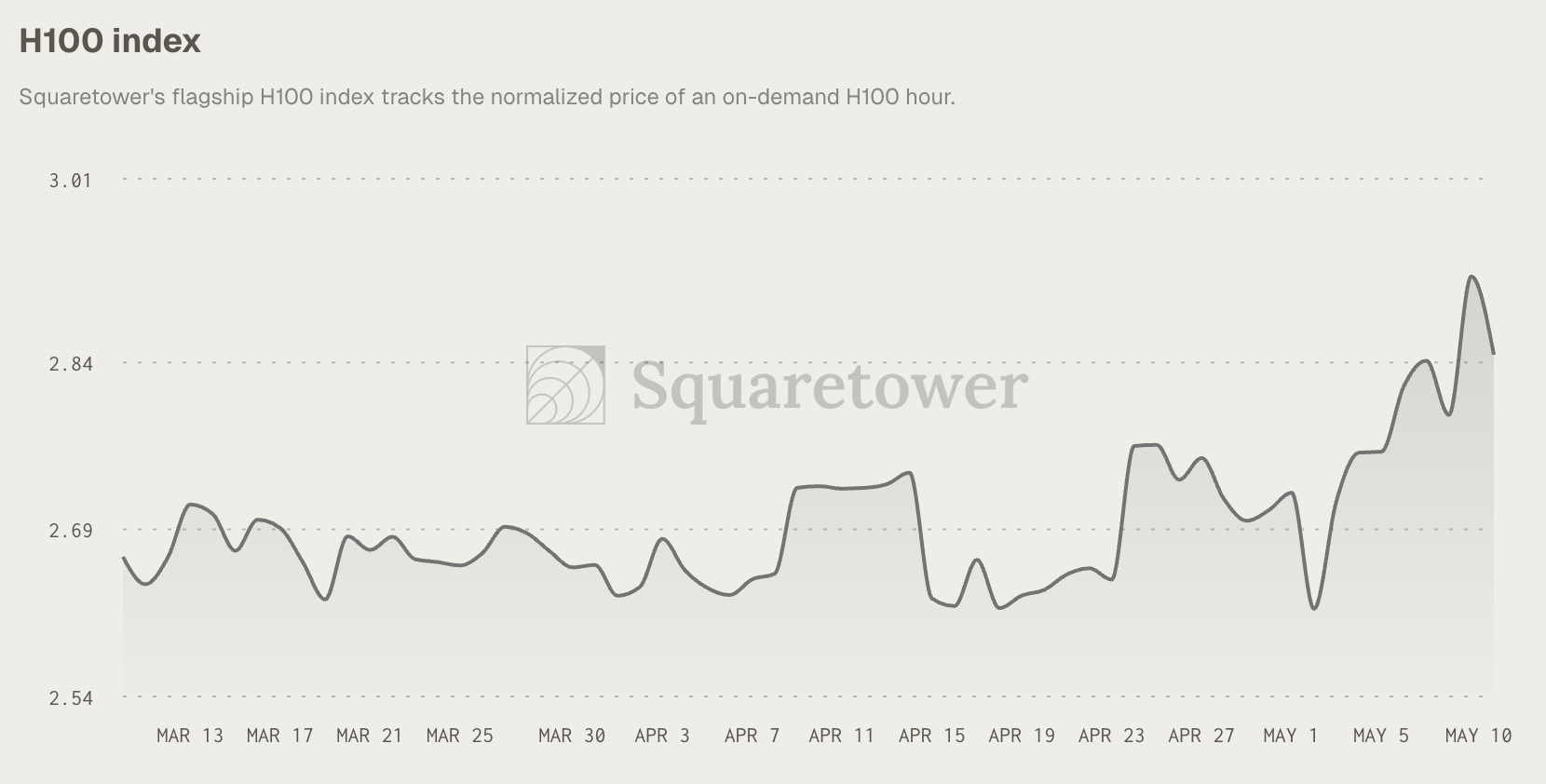
We immediately saw the demand, and so did the market. H100 market tightness jumped 200% overnight, literally. In the following three weeks, on-demand H100 instance prices increased by ~9%.
We also saw something shielded from the public compute markets: a flurry of non-standard capacity requests across exotic sizes, durations, and shapes. According to our internal analysis, the 1-month implied tenor forward rate jumped from $2.33 to $2.44 in the last month, while 12-month implied forward rates for short tenors remained relatively stable, implying short-term uncertainty and repricing but a generally soft market attitude towards end-of-term residual values. However, we showed 12 month contracts for reserved H100 capacity jumping 20% during this time. Many of these buyers directly attributed these abnormal needs to V4’s release. This is telling in and of itself. Who would restructure their entire contract posture if they believed a price move to be transient?
A novel compute market shock
The structural point is this: frontier lab models absorb capacity from their walled garden. The Anthropics and OpenAIs of the world have the ability to provision their own capacity in either their existing infrastructure, extremely large blocks with long lead times, or through hyperscaler partners, and this activity does not hit the broader market in the same manner as dropping an open-source, frontier-capable model. The effects of closed-source model compute provisioning exist, but so obscured to the outside world that in short enough tenors, they are invisible. Reports of a new closed model release immediately demonstrating an increase in H100 prices are generally ill-concluded. Anthropic’s recent issues with severe rate-limiting of Claude are a reminder that frontier lab provisioning is not infinitely elastic. Conversely, OpenAI’s ability to continually outbid or build large clusters eats away at card allocation. Compared to the more fragmented but broader market, these phenomena are comparatively steady and constant. Predictable.
Open weights are fundamentally different. DeepSeek immediately externalized demand to the rest of the market the moment it shipped V4. Neoclouds, research labs, and enterprises running V3 or R1 all were forced to immediately consider running V4 and procuring the compute needed or be left behind. Prices and market tightness were hit immediately. We’ll continue to see this as more capable open source models are released. In addition, more companies are turning to in-house finetuning at a scale heretofore unprecedented, even since 2024 — while we saw techniques such as LoRA adapters making finetuning more efficient at scale, requiring less GPUs to train task-optimized models in 2024, we’re now seeing the reverse; sophisticated post-training techniques like in-house refined RL environments and data augmentation that make proprietary and complex enterprise data more efficient and usable are bringing the importance of post-training on open weights to the broader market.
The difference here is categorical: the last three weeks of compute markets look markedly different than before April 22nd. Closed models internalize their compute demand, resulting in long-term price wars on-market and rising demand floors, while open models immediately externalize it. Open models exist in a subset of the compute market where demand already dwarfs a relatively fragmented supply. In this context, this kind of market shock serves to reinforce compute scarcity.
What follows
Some of the implications of this are relatively straightforward; some are not.
First, the open-weight release calendar can be translated to a compute market calendar. Some releases matter more than others. A parallel to DeepSeek’s “R1 moment” that we witnessed in early 2025 clearly is partly responsible for the flurry of activity seen over the last three weeks. In terms of capabilities, Gemma 4 is a fantastic model, but it does not have the same mental purchase as DeepSeek for this reason.
Second, the underlying, moving dynamics of the compute market can be observed effectively in real time thanks to benchmarks like our H100 index, tightness index, and forward curves. However, not all price signals are instant. This is a textbook opportunity for financialization. It is also alpha for those who can discern these market dynamics over those who cannot.
Third, compute exposure is risk that is incredibly difficult to hedge in the current day. Internally, we have seen sudden shifts in long-tenor capacity costs that could fundamentally alter or even quash the viability of plenty of startups as more companies bid for dwindling supply. (If you are a venture investor, you should be asking your portfolio companies how they plan to handle this risk.) This kind of market shock could prove materially consequential in the long term for the growth stage and beyond. If compute is the moat, effective risk management is a necessary piece of the defensibility puzzle.
There has been a lot of talk lately about how compute is starting to look like a real commodities market now. But the infrastructure for treating it like one does not exist yet. Compute futures markets fall short compared to the scale and types of risks that the AI economy will generate. Enterprises need to adopt new ways of treating compute as a heavy financial asset, but existing prescriptions fail to understand the real risks they face in compute procurement. Today’s risk management playbooks are insufficient. The demand for this infrastructure just announced itself.
Squaretower develops research, data, and tools for compute markets. Learn more about us or follow us on X.